
Ancient Egypt
2026-04-05
Introduction
Ancient Egypt stands as one of
humanity's most remarkable civilizations, flourishing for over three millennia
from around 3100 BCE until its annexation by Rome in 30 BCE. Spanning the
Predynastic, Old, Middle, New Kingdoms, and Late Periods, this society produced
enduring wonders that continue to captivate the world. Its legacy in monumental
architecture, sophisticated writing, and profound ingenuity offers profound
insights into human achievement, making it a cornerstone of historical study.
The Nile River formed the backbone
of Ancient Egyptian life, its annual floods depositing nutrient-rich silt that
sustained agriculture in an otherwise arid landscape. This fertile Nile Valley
contrasted sharply with the encircling deserts, which served as natural
defenses. Upper Egypt stretched south along the river's length, Lower Egypt
occupied the northern Delta, and pivotal cities like Memphis—near modern
Cairo—and Thebes (Luxor) anchored political and cultural power.
The Pharaohs
Pharaohs embodied divine kingship,
viewed as living gods who maintained cosmic order. Iconic rulers included
Narmer, who unified Egypt around 3100 BCE; Khufu, builder of the Great Pyramid;
female pharaoh Hatshepsut, renowned for trade expeditions; boy-king
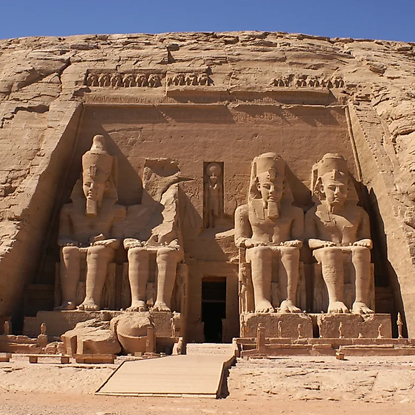
Tutankhamun, whose tomb yielded treasures; and Ramses II, the builder of vast
monuments. They oversaw monumental projects, their reigns marked by elaborate
burials preparing for eternity.
Egyptian society followed a rigid
hierarchy: pharaohs at the apex, followed by nobles, priests, scribes,
artisans, farmers, and slaves at the base. Daily life revolved around the
inundation cycle, with farmers tilling barley and emmer wheat, while artisans
crafted jewelry and linen. Families lived in mud-brick homes, women enjoyed
legal rights including property ownership, and children attended scribal
schools or apprenticed early. Diets featured bread, beer, fish, and vegetables.
Art & Architecture
Art and architecture achieved
unparalleled grandeur, exemplified by the Giza Pyramids—Khufu's Great Pyramid
standing 146 meters tall—Djoser's Step Pyramid, the enigmatic Sphinx, and
rock-cut tombs in the Valley of the Kings.
Temples at Karnak and Luxor featured towering pylons and hypostyle halls,
while obelisks symbolized eternal power. Art adhered to rigid conventions:
hieroglyphic inscriptions, idealized human forms in profile, and symbolic
proportions glorifying eternity over realism.
Scientific and technological
prowess underpinned these feats. Hieroglyphs evolved into hieratic and demotic
scripts for administration, enabling literature like the Tale of Sinuhe.
Egyptians developed a 365-day solar calendar, advanced mathematics for pyramid
construction, and medical papyri detailing surgeries, herbal remedies, and
childbirth. Engineering innovations included shadufs for irrigation, massive
ramps for stone transport, and precise quarrying techniques that shaped
enduring limestone and granite monuments.
Decline and Legacy
Decline came gradually through
periods of fragmentation and foreign influences, from Persians and Greeks under
Alexander to the Ptolemies, culminating in Cleopatra VII's era and Roman
annexation. Yet, Ancient Egypt's influence endures, now vividly showcased at
the Grand Egyptian Museum (GEM) near the Pyramids. The GEM's King Tut room
displays over 5,000 treasures from his tomb in immersive splendor, bringing
this golden age to life.
Ancient Egypt's brilliance—from
pyramids piercing the sky to intricate artifacts—inspires awe and invites
exploration. Book your package today to discover Cairo's Giza wonders, Luxor's
Valley of the Kings, and Aswan's Nile felucca sails, creating memories that
echo eternity.
 2026-06-07
 2026-05-03
 2025-07-07